
Climate and Road Conditions for Cycling in Okinawa | Best Season and Precautions for Riders
Okinawa is a popular cycling destination among many cyclists, offering the chance to ride amidst blue seas and lush natural scenery.
The climate differs significantly from that of Honshu; it remains relatively warm even in winter, making it a major attraction for those who enjoy cycling year-round.
On the other hand, Okinawa has its own unique characteristics, such as strong UV rays, high humidity, and a climate with frequent rain. Road conditions also vary by region in terms of traffic volume and road surface, so being aware of these factors in advance will help you enjoy cycling more safely.
Here’s what you need to know about the climate, the best time of year, and road conditions for cycling in Okinawa.
Okinawa has a warm climate that is ideal for cycling
Compared to Honshu, Okinawa experiences milder temperature fluctuations, making it a region where you can ride a bicycle on many days throughout the year.
It remains relatively warm even in winter, making it a popular destination for off-season training and recreational cycling.
In addition, because Okinawa has its own unique climate—including strong UV rays, the rainy season, and typhoons—it’s important to be aware of the characteristics of each season.
It stays warm even in winter, and the roads rarely freeze over
Okinawa enjoys a warm climate year-round, and roads rarely freeze over as they do in Honshu during the winter.
As a result, cycling is relatively comfortable even in winter, making it a popular destination for off-season training and cycling trips.
Especially from January through March, temperatures are higher than on Honshu, making it easier to ride, so this season is popular among cyclists who want to enjoy winter rides.
Ultraviolet rays and humidity are characteristic of Okinawa
Okinawa is a region with strong sunlight and high levels of UV radiation throughout the year.
Therefore, it is important to take precautions against sunburn when cycling.
Also, since summers are hot and humid, it’s important to stay hydrated regularly to prevent heatstroke.
The Best Season for Cycling in Okinawa
If you want to enjoy cycling in Okinawa, the period from fall through spring is especially recommended.
From October through April, temperatures are relatively mild, making it a comfortable season for long-distance cycling.
On the other hand, since temperatures and humidity rise in the summer, you’ll need to take precautions against the heat, such as riding during cooler times of the day, like early morning or evening.
Climate and Clothing Guidelines for Cycling in Okinawa
While Okinawa enjoys a warm climate year-round, temperatures, precipitation, and how the weather feels can vary significantly depending on the season.
In particular, the rainy season, the intense summer sun, and typhoon season can all affect your cycling plans.
First, let’s take a look at the trends in Okinawa’s annual temperature and precipitation in the graph below.
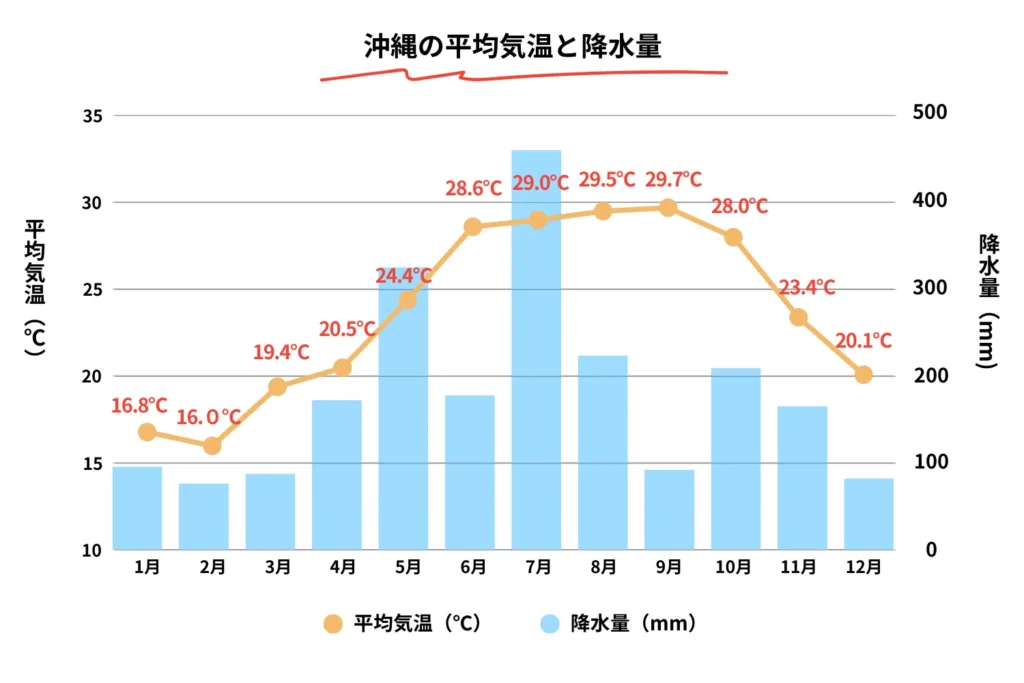
Source: Japan Meteorological Agency website / Monthly weather data for Okinawa Prefecture (Naha) (2025)
Okinawa Cycling Trip Calendar
When cycling in Okinawa, it’s important to understand the seasonal climate and adjust your clothing and gear accordingly.
Use the monthly climate and clothing guidelines as a reference to plan a comfortable cycling trip.
| Month | Average temperature | Firsthand experience | Recommended Attire |
|---|---|---|---|
| 1月 | 約16℃ | A bit chilly | This is the time of year when strong north winds blow and rainy days become more frequent. In addition to sports base layers, you’ll feel more comfortable wearing two layers of long-sleeved cycling jerseys or pairing a long-sleeved jersey with a windbreaker (a sleeveless one is fine too). For bottoms, we recommend fleece-lined long tights. |
| 2月 | 約17℃ | A bit chilly | This is a time of year when temperatures fluctuate and the weather is unpredictable. Wearing a sports base layer and a long-sleeve jersey, and keeping a raincoat on hand in case of sudden rain, will give you peace of mind while riding. |
| 3月 | 約19℃ | It's getting warmer | As temperatures rise, it’s becoming the perfect season for running. Start with a sports base layer and a lightweight long-sleeve jersey, and add a rain jacket or leg warmers as needed for comfort. |
| 4月 | 約21℃ | It's getting warmer | The weather in Okinawa feels like early summer. While you can run in short sleeves, it’s a good idea to wear a long-sleeve base layer to help regulate your body temperature. Shorts are fine, and for women, we recommend lightweight long tights. |
| 5月 | 約24℃ | The rainy season has begun, and humidity and rainfall are on the rise. Pairing a short-sleeved shirt with a raincoat gives you peace of mind. Shorts are comfortable, and women can wear thin long tights to protect against sunburn. | |
| 6月 | 約27℃ | It’s still hot and humid, but it’s the perfect season for a comfortable run in short sleeves. If you’re concerned about the sun, arm sleeves come in handy. Shorts are fine, too. | |
| 7月 | 約29℃ | It's extremely hot | Summer is finally here in full swing. Since the sun is getting stronger, it’s fine to wear light clothing (short sleeves), but be sure to take proper precautions against heatstroke and UV rays. |
| 8月 | 約29℃ | It's extremely hot | This is the time of year when, in addition to strong sunlight, sudden downpours become more frequent. It’s best to stick to light clothing (short sleeves) and keep both UV protection and rain gear in mind for peace of mind. |
| 9月 | 約28℃ | It's extremely hot | While the heat continues, this is a time when the weather can change quickly due to typhoons. Wearing light clothing (short sleeves) and carrying a raincoat will give you peace of mind while running. |
| 10月 | 約25℃ | It's getting cooler | The sun’s rays have softened, making this a very pleasant season for cycling. While there are many days when you can ride in a T-shirt and shorts, it’s handy to have arm warmers on hand for the mornings and evenings. |
| 11月 | 約22℃ | It's getting cooler | The pleasant weather continues. While short sleeves and shorts are fine during the day, it gets a bit chilly in the mornings and evenings, so wearing arm warmers is just right. |
| 12月 | 約19℃ | It's getting cold | As cloudy days become more frequent, you’ll start to feel the wind more easily. You’ll be able to run comfortably by layering a lightweight long-sleeve shirt or long-sleeve base layer, and pairing shorts with leg warmers. |
UV Rays in Okinawa and How to Protect Yourself While Cycling
Okinawa experiences strong UV rays year-round, and UV levels there are often higher than on Honshu, especially from spring through summer.
Since there is little shade while cycling, it’s important to take precautions against UV rays as well as high temperatures.
Characteristics of UV radiation levels in Okinawa
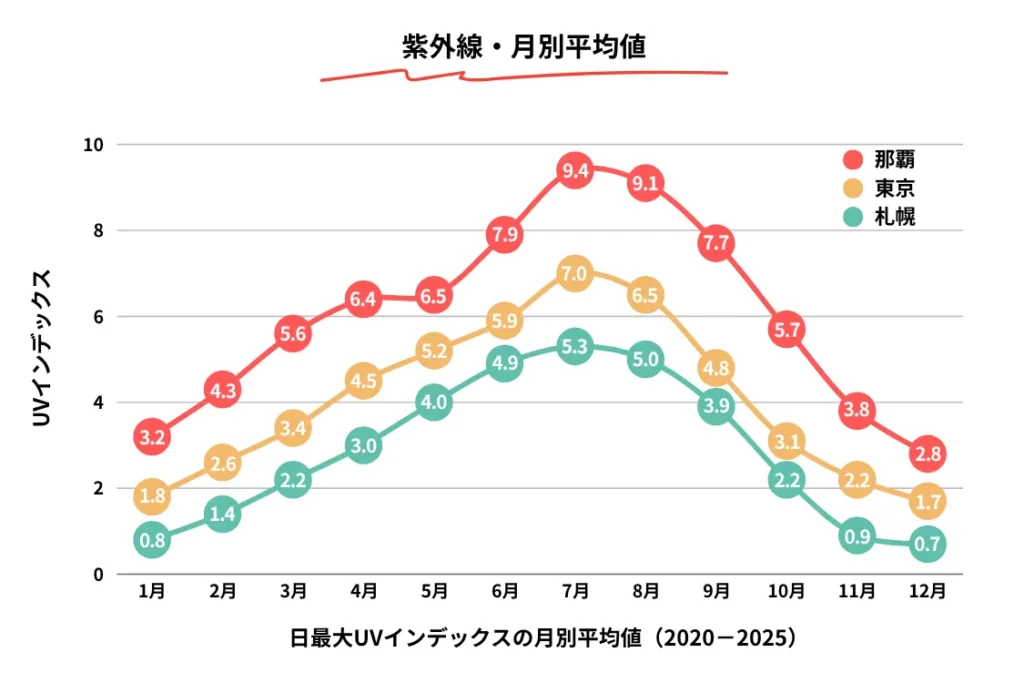
Source: Japan Meteorological Agency website / Annual trend graph of the daily maximum UV index (calculated values)
UV levels in Okinawa begin to rise in early spring and reach very high levels during the summer.
The sun is particularly intense in July and August, making it easy to feel the effects on your skin even after brief exposure.
Even compared to Tokyo or Sapporo, temperatures remain high throughout the year, so it’s not uncommon to feel that “the sun is stronger than the temperature suggests.”
UV Index Guidelines and Effects
The UV Index is a measure of ultraviolet radiation intensity; different numerical values correspond to different levels of caution and are classified as follows:
In Okinawa, there are many days during the summer when the UV Index remains at "8 or higher," so extra caution is required when cycling.

Source: Ministry of the Environment, "Manual on Environmental Health and Ultraviolet Radiation"
UV Protection While Cycling
Since cycling involves spending long periods of time outdoors, it’s important to combine multiple preventive measures.
- Wearing long-sleeve undershirts or arm warmers
- Sunglasses with UV protection
- Reapply sunscreen frequently
- Choose a time of day, such as early morning or evening
- Take frequent breaks and stay hydrated
When it comes to clothing, even in the summer, opting for lightweight fabrics and covering up more will ultimately make for a more comfortable run.
Road Conditions and Cycling Characteristics in Okinawa
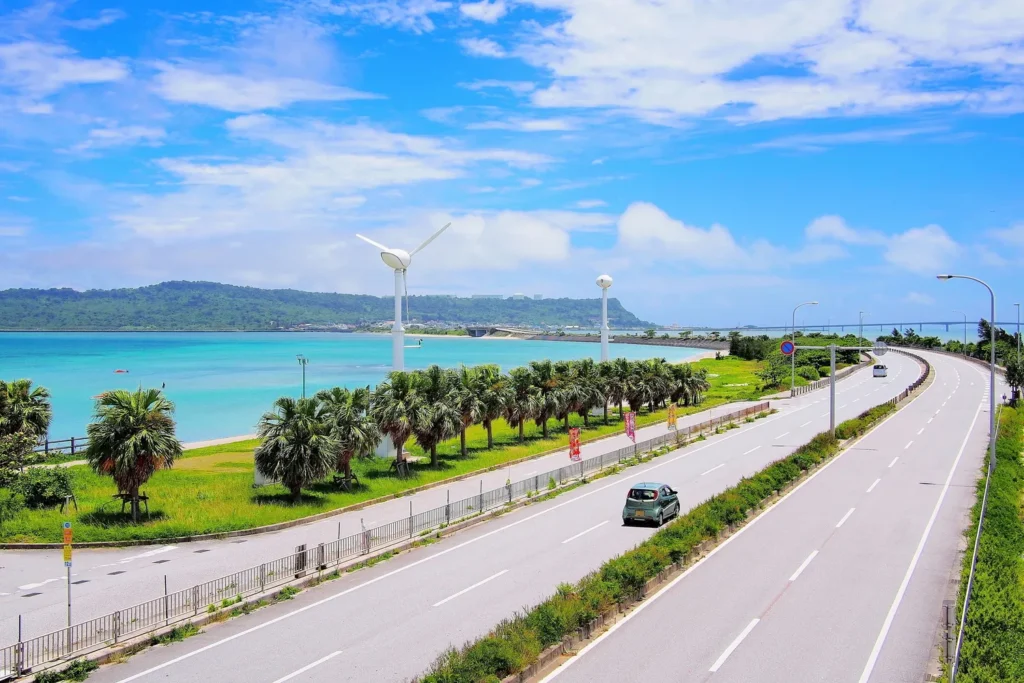
Okinawa offers a variety of roads that are ideal for cycling, including scenic coastal routes and hilly paths.
Since traffic volume and road conditions vary by region, understanding these characteristics will help you enjoy a more comfortable ride. Here, we’ll introduce Okinawa’s road conditions and the unique features of cycling there.
On rainy days, the roads can be slippery
Roads in Okinawa are sometimes paved with Ryukyu limestone, which is derived from coral reefs.
As a result, the road surface can become slippery on rainy days.
Be sure to slow down, especially on curves and downhill slopes, and drive safely.
A scenic coastal road
One of the main attractions of cycling in Okinawa is the abundance of routes where you can ride while enjoying views of the ocean.
For example, the following areas are popular routes where you can ride while taking in the scenery.
- Underwater Road
- Around Kouri Island
- Senaga Island Area
Cycling while feeling the sea breeze is one of the unique charms of Okinawa.
The northern area has light traffic and is easy to drive in
The "Yanbaru Area" in northern Okinawa Island is rich in natural beauty and has relatively light traffic, making it an ideal environment for cycling.
With few traffic lights and many hilly routes, it is popular among cyclists who enjoy long rides or use it for training.
With plenty of ups and downs, it's perfect for training
Okinawa's roads often follow the coastline or wind through hilly terrain, offering plenty of routes with ups and downs.
Since the route includes not only flat sections but also moderate climbs, it’s ideal for training rides. In fact, it’s sometimes used as a training camp location for professional teams.
Things to Keep in Mind When Cycling in Okinawa
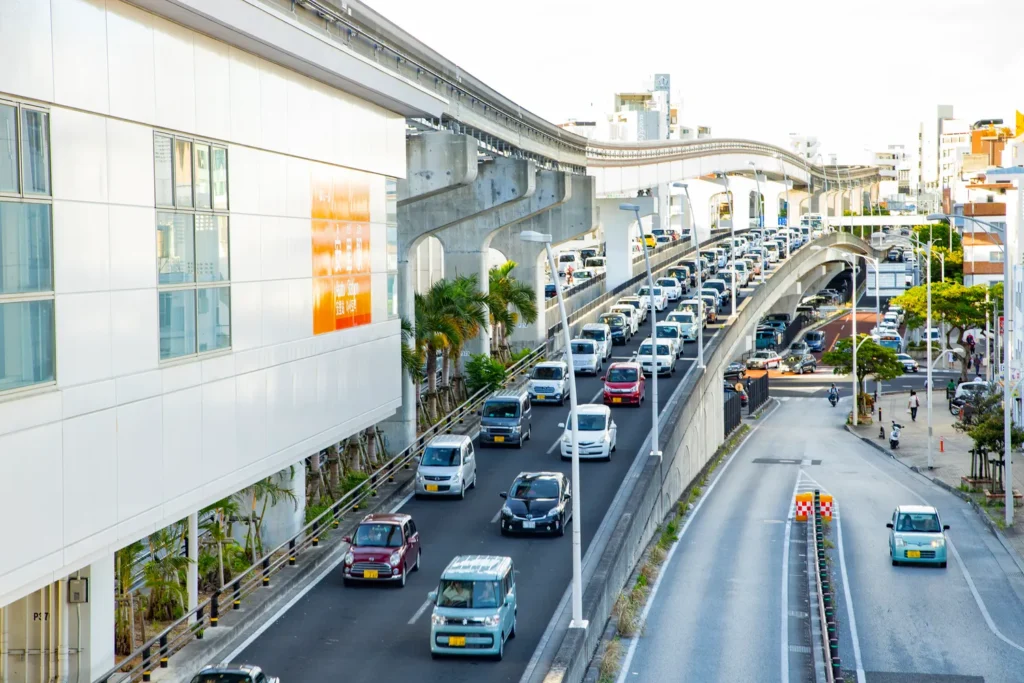
There are a few things to keep in mind when cycling in Okinawa.
Knowing these details in advance—especially regarding roads with heavy traffic and typhoon season—will help ensure your safety. Take the time to understand Okinawa’s unique environment so you can enjoy cycling with peace of mind.
Since this is a car-dependent society, please be mindful of traffic
Since Okinawa is a car-dependent society, traffic tends to be heavy in urban areas and on major roads.
Traffic moves quickly, especially in Naha City and on major highways, so be sure to maintain a safe following distance and drive at a comfortable pace.
Be careful of sections with narrow shoulders and road conditions
In some parts of Okinawa, road shoulders may be narrow, and the condition of the pavement can vary.
Since sand and small stones tend to accumulate in certain areas, please be careful not to drive too fast.
Typhoon season
From summer through fall, the area may be affected by typhoons.
Strong winds can make driving dangerous, so be sure to check the weather forecast in advance and plan a schedule that allows for flexibility.
Wind conditions (take extra care along the coast)
Since Okinawa is surrounded by the ocean, strong winds can blow on certain days.
Coastal routes are particularly susceptible to crosswinds, so please exercise extreme caution when steering.
Checking the Refreshment and Rest Stops
In some suburban areas and on remote islands, there may be stretches with few convenience stores or vending machines.
It’s a good idea to check the rest stops along your route before you set out.
Okinawa is a cycling paradise you can enjoy all year round
Okinawa boasts a warm climate and beautiful natural scenery, making it a region where you can enjoy cycling all year round.
There are also many attractive routes unique to Okinawa, such as scenic coastal roads and the nature-rich northern area.
On the other hand, since Okinawa has its own unique characteristics—such as intense UV rays, high humidity, and road conditions—it’s important to familiarize yourself with the climate and driving conditions in advance.
Learn about the best seasons and road conditions, get everything ready, and enjoy a cycling experience unique to Okinawa.